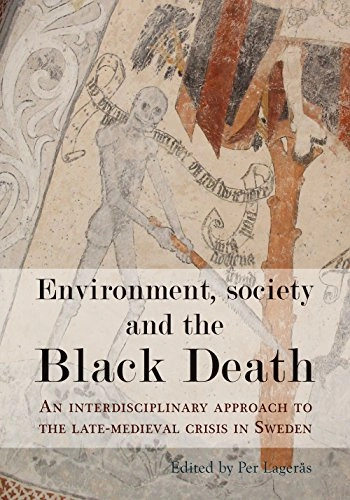
Environment, society and the Black Death : an interdisciplinary approach to the late-medieval crisis in Sweden
- Utgiven: 2016
- ISBN: 9781785700545
- Förlag: Oxbow Books
- Format: Häftad
- Språk: Engelska
Om boken
In the mid-fourteenth century the Black Death ravaged Europe, leading to dramatic population drop and social upheavals. Recurring plague outbreaks together with social factors pushed Europe into a deep crisis that lasted for more than a century. The plague and the crisis, and in particular their short-term and long-term consequences for society, have been the matter of continuous debate. Most of the research so far has been based on the study of written sources, and the dominating perspective has been the one of economic history. A different approach is presented here by using evidence and techniques from archaeology and the natural sciences. Special focus is on environmental and social changes in the wake of the Black Death. Pollen and tree-ring data are used to gain new insights into farm abandonment and agricultural change, and to point to the important environmental and ecological consequences of the crisis. The archaeological record shows that the crisis was not only characterized by abandonment and decline, but also how families and households survived by swiftly developing new strategies during these uncertain times. Finally, stature and isotope studies are applied to human skeletons from medieval churchyards to reveal changes in health and living conditions during the crisis. The conclusions are put in wider perspective that highlights the close relationship between society and the environment and the historical importance of past epidemics.Table of ContentsPrefacePart I. Introduction1. An interdisciplinary approach (Per Lager�s)2. Current knowledge on the late-medieval crisis (Per Lager�s)3. Societal crisis and environmental change (Per Lager�s)Part II. Empirical studies4. Abandonment, agricultural change and ecology (Per Lager�s, Anna Brostr�m, Daniel Fredh, Hans Linderson, Anna Berg, Leif Bj�rkman, Tove Hultberg, Sven Karlsson, Matts Lindbladh, Florence Mazier, Ulf Segerstr�m & Eva Sk�ld)5. Change, desertion and survival – an archaeology of the late-medieval crisis (Lars Ersg�rd)6. Living conditions in times of plague (Caroline Arcini, T. Douglas Price, Maria Cinthio, Leena Drenzel, Mats Andersson, Bodil Persson, Hanna Menander, Maria Vretemark, Anna Kjellstr�m, Rickard Hedvall and G�ran Tagesson)Part III. Conclusions in a wider perspective7. Environment–society interactions (Per Lager�s)8. Studying the late-medieval crisis – reflections on research perspectives (Lars Ersg�rd)9. Epidemics in a social context (Caroline Arcini)10. Summary of conclusions (Per Lager�s)Author presentationsReferencesAppendix 1. Pollen sitesAppendix 2. Osteological stature dataAppendix 3. Isotope data
Åtkomstkoder och digitalt tilläggsmaterial garanteras inte med begagnade böcker
Mer om Environment, society and the Black Death : an interdisciplinary approach to the late-medieval crisis in Sweden (2016)
2016 släpptes boken Environment, society and the Black Death : an interdisciplinary approach to the late-medieval crisis in Sweden skriven av Per Lagerås. Den är skriven på engelska. Förlaget bakom boken är Oxbow Books.
Köp boken Environment, society and the Black Death : an interdisciplinary approach to the late-medieval crisis in Sweden på Studentapan och spara pengar.
Referera till Environment, society and the Black Death : an interdisciplinary approach to the late-medieval crisis in Sweden
Harvard
Lagerås, P. (2016). Environment, society and the Black Death : an interdisciplinary approach to the late-medieval crisis in Sweden. Oxbow Books.
Oxford
Lagerås, Per, Environment, society and the Black Death : an interdisciplinary approach to the late-medieval crisis in Sweden (Oxbow Books, 2016).
APA
Lagerås, P. (2016). Environment, society and the Black Death : an interdisciplinary approach to the late-medieval crisis in Sweden. Oxbow Books.
Vancouver
Lagerås P. Environment, society and the Black Death : an interdisciplinary approach to the late-medieval crisis in Sweden. Oxbow Books; 2016.