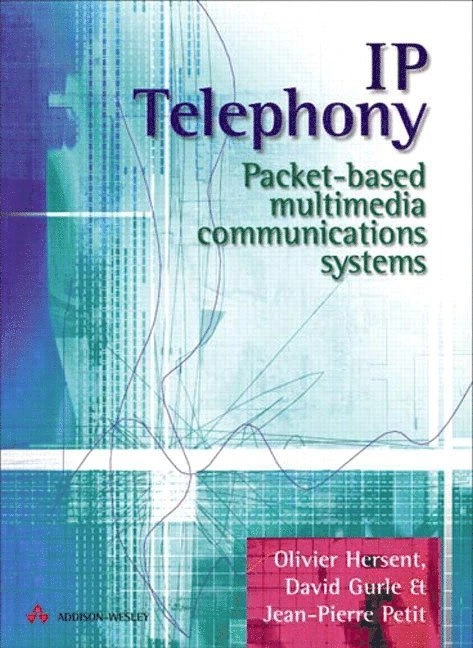
IP telephony : packet-based multimedia communications systems Upplaga 1
- Upplaga: 1a upplagan
- Utgiven: 2000
- ISBN: 9780201619102
- Sidor: 480 st
- Förlag: Addison-Wesley
- Format: Häftad
- Språk: Engelska
Om boken
Foreword Jeff Pulver
Preface
SECTION 1 The application layer, IP telephony protocols
H.323 and a general background on IP telephony
A little history
Where to find documentation
From RTP to H.323: a quick tour
Transporting voice over a packet network
A Darwinian view of voice transport
Voice and video over IP with RTP and RTCP
H.323 step by step
The “hello world” case: simple voice call from terminal A to terminal B
A more complex case: calling a public phone from the Internet
H.323 across multiple domains
Advanced topics
Faster procedures
Conferencing with H.323
Directories and numbering
H.323 security: H.235
Media streams
Codecs
DTMF
Fax
Supplementary services using H.450
H.450.1
H.450.2: call transfer
H.450.3: call diversion
The future of H.450
Future work on H.323
The session initiation protocol (SIP)
The origin and purpose of SIP
Overview of a simple SIP call
SIP messages
Session description syntax, SDP
Advanced services with SIP
SIP entities
User location and mobility
Multiparty conferencing
Configuring network-based call handling
Billing SIP calls
SIP security
Media security
SIP firewalls
SIP and H.323
What SIP does and H.323 does not
What H.323 does and SIP does not
H.323 to SIP gateways
Conclusion on the future of SIP and its relation to H.323
Media gateway to media controller protocols (MGCP)
Introduction
Which protocol?
What about the requirements?
A new architecture for IP telephony?
What is MGCP?
MGCP commands
Protocols at work
Scenario 1
Scenario 2
The H.323 case
SECTION 2 Voice technology background
Voice quality
Introduction
Reference connection
Echo in a telephone network
Talker echo, listener echo
Hybrid echo
Acoustic echo
How to limit echo
Delay in a telephone network
Influence of the operating system
Influence of the jitter buffer policy on delay
Influence of the codec, frame grouping and redundancy
Consequence for measuring end-to-end delay
Acceptability of a phone call with echo and delay
Consequences for an IP telephony network
The approach of ETSI TIPHON
Other requirements for gateways and transcoding equipment
Voice coding
Introduction
Transmitted bandwidth, sampling and quantization
Some basic tools for digital signal processing
The A or u law ITU-T 64 kbit/s G.711
Specifications and subjective quality of
speech coders
ACR subjective test or what is the MOS
Speech and auditory properties
Speech production
Auditory perception used for speech and audio bitrate reduction
Quantization and coders
Adaptive quantizers
Differential (and predictive) quantization
Vector quantization
Entropy coding
Waveform coders: the ADPCM ITU-T G.726
Wideband speech coding using waveform-type coder
Speech coding techniques
Hybrids and analysis by synthesis speech coders
The GSM Full Rate RPE-LTP speech coder
Codebook excited linear predictive (CELP) coders
The ITU-T 8 kbit/s CS-ACELP G.729
The ITU-T G.723.1
Discontinuous transmission and comfort noise generation
The low delay CELP coding scheme: ITU-T G.728
Partial conclusion on speech coding techniques and their near future
Remarks applicable to VolP telephone gateways
The electrical echo canceller
Best effort
Non-standardization
SECTION 3 The network
Quality of service
What is QoS?
Describing a stream
Queuing techniques for QoS
Signaling QoS requirements
RSVP
Scaling issues with RSVP
Classes of service in the backbone
RSVP to Diffserv mapping
Improving QoS in the best-effort class
Issues with slow links
Conclusion
Network dimensioning
Simple compressed voice flow model
Voice coders
Model for N simultaneous conversations using the same coder
Loss rate and dimensioning
Packet or frame loss?
Multiple coders
Network dedicated to IP telephony
Is it necessary?
Network dimensioning
Merging data communications and voice communications on a common IP backbone
Prioritization of voice flows
Impact on end-to-end delay
Multipoint communications
Audio multipoint conferences
Multipoint video conferencing
Modeling call seizures
Introduction to the Erlang model
Model for a limited set of servers and calls are rejected if no server is available
Calls per second
Conclusion
Multicast routing
Introduction
When to use multicast routing
A real-time technology
Network efficiency
The multicast framework
Multicast address, multicast group
Multicast on Ethernet
Group membership protocol
Controlling scope in multicast applications
Scope versus initial TTL
TTL threshold
Administrative scoping
Building the multicast delivery tree
Flooding and spanning tree
Shared trees
Source-based trees
Multicast routing protocols
DVMRPv3
Other protocols
Core-based trees
Security issues in IP multicast
Unauthorized listening
Unauthorized sending and denial of service attacks
Firewalls
The MBONE
Routing protocols
Inter-domain multicast routing
Interoperational between domains running
different protocols
BGMP
Conclusion on multicast inter-domain routing
Multicast caveats
Multicasting on non-broadcast media
Flooding
Common issues
Address allocation
MBONE applications
Video conferencing with RTP on multicast networks
SDR: session directory
VIC and VAT
Reliable multicast
Appendix: well known multicast addresses
References
Glossary
Index
Åtkomstkoder och digitalt tilläggsmaterial garanteras inte med begagnade böcker
Mer om IP telephony : packet-based multimedia communications systems (2000)
2000 släpptes boken IP telephony : packet-based multimedia communications systems skriven av Olivier Hersent, David Gurle, Jean-Pierre Petit. Det är den 1a upplagan av kursboken. Den är skriven på engelska och består av 480 sidor. Förlaget bakom boken är Addison-Wesley.
Köp boken IP telephony : packet-based multimedia communications systems på Studentapan och spara pengar.
Referera till IP telephony : packet-based multimedia communications systems (Upplaga 1)
Harvard
Hersent, O., Gurle, D. & Petit, J.-P. (2000). IP telephony : packet-based multimedia communications systems. 1:a uppl. Addison-Wesley.
Oxford
Hersent, Olivier, Gurle, David & Petit, Jean-Pierre, IP telephony : packet-based multimedia communications systems, 1 uppl. (Addison-Wesley, 2000).
APA
Hersent, O., Gurle, D., & Petit, J.-P. (2000). IP telephony : packet-based multimedia communications systems (1:a uppl.). Addison-Wesley.
Vancouver
Hersent O, Gurle D, Petit JP. IP telephony : packet-based multimedia communications systems. 1:a uppl. Addison-Wesley; 2000.
citeproc-js implements the Citation Style Language. (c) Frank Bennett. Licenser och källkod.