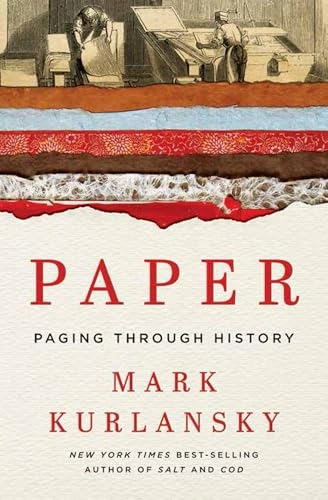
Paper : paging through history Upplaga 1
- Upplaga: 1a upplagan
- Utgiven: 2016
- ISBN: 9780393239614
- Sidor: 416 st
- Förlag: W.W. Norton & Company
- Format: Inbunden
- Språk: Engelska
Om boken
Paper is one of the simplest and most essential pieces of human technology. For the past two millennia, the ability to produce it in ever more efficient ways has supported the proliferation of literacy, media, religion, education, commerce and art. It has created civilisations, fostering the fomenting of revolutions and the stabilising of regimes. History’s greatest press run produced 6.5 billion copies of Máo zhu xí yu lu, Quotations from Chairman Mao Tse-tung (Zedong) and Leonardo da Vinci left behind only 15 paintings but 4,000 works on paper. Now, on the cusp of "going paperless"—and amid speculation about the effects of a digitally dependent society—we’ve come to a world-historic juncture to examine what paper means to civilisation.
Through tracing paper’s evolution, Mark Kurlansky challenges common assumptions about technology’s influence, affirming that paper is here to stay. Paper will be the history that guides us forward in the twenty-first century.
Åtkomstkoder och digitalt tilläggsmaterial garanteras inte med begagnade böcker
Mer om Paper : paging through history (2016)
2016 släpptes boken Paper : paging through history skriven av Mark Kurlansky. Det är den 1a upplagan av kursboken. Den är skriven på engelska och består av 416 sidor. Förlaget bakom boken är W.W. Norton & Company.
Köp boken Paper : paging through history på Studentapan och spara pengar.
Referera till Paper : paging through history (Upplaga 1)
Harvard
Kurlansky, M. (2016). Paper : paging through history. 1:a uppl. W.W. Norton & Company.
Oxford
Kurlansky, Mark, Paper : paging through history, 1 uppl. (W.W. Norton & Company, 2016).
APA
Kurlansky, M. (2016). Paper : paging through history (1:a uppl.). W.W. Norton & Company.
Vancouver
Kurlansky M. Paper : paging through history. 1:a uppl. W.W. Norton & Company; 2016.
citeproc-js implements the Citation Style Language. (c) Frank Bennett. Licenser och källkod.