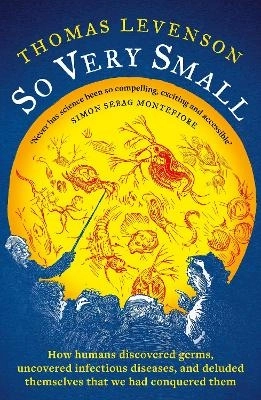
So Very Small
- Utgiven: 2026
- ISBN: 9781800249080
- Sidor: 448 st
- Förlag: Bloomsbury Publishing Ltd.
- Format: Häftad
- Språk: Engelska
Om boken
In 1665, an infectious disease swept through the British capital and claimed the lives of tens of thousands of people. It would take another two hundred years for the cause of the Great Plague of London to be confirmed: a powerful bacterium called Yersinia pestis. In those centuries, our understanding of diseases was transformed.
In So Very Small, Thomas Levenson reveals how human hubris led us to overestimate our own ability and underestimate the threat that microorganisms truly pose. He journeys through some of the most significant epidemics and pandemics in history, including the recurrent outbreaks of cholera in Europe and Asia, and the
1721 Boston smallpox epidemic.
The turning point came in the nineteenth century with the development of germ theory: the concept that microbes can cause disease. Levenson shows how, in the years that followed, scientists made major breakthroughs in our ongoing struggle against infectious disease. Perhaps the greatest of these achievements is the discovery of antibiotic treatment, which has been the salvation of much of humanity in recent centuries.
In a story that spans centuries and continents, So Very Small explores the scientific quest to understand how tiny organisms have impacted the wider world - and looks ahead to the battle to fight their rapid evolution.
Åtkomstkoder och digitalt tilläggsmaterial garanteras inte med begagnade böcker
Mer om So Very Small (2026)
I februari 2026 släpptes boken So Very Small skriven av Thomas Levenson. Den är skriven på engelska och består av 448 sidor. Förlaget bakom boken är Bloomsbury Publishing Ltd..
Köp boken So Very Small på Studentapan och spara pengar.
Referera till So Very Small
Harvard
Levenson, T. (2026). So Very Small. Bloomsbury Publishing Ltd.
Oxford
Levenson, Thomas, So Very Small (Bloomsbury Publishing Ltd., 2026).
APA
Levenson, T. (2026). So Very Small. Bloomsbury Publishing Ltd.
Vancouver
Levenson T. So Very Small. Bloomsbury Publishing Ltd.; 2026.
citeproc-js implements the Citation Style Language. (c) Frank Bennett. Licenser och källkod.