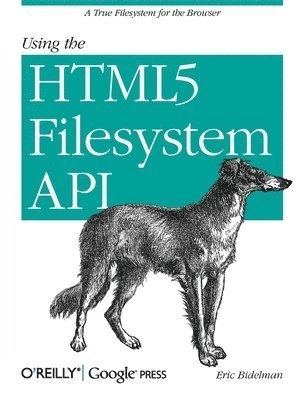
Using the HTML5 Filesystem API Upplaga 1
- Upplaga: 1a upplagan
- Utgiven: 2011
- ISBN: 9781449309459
- Sidor: 74 st
- Förlag: O'Reilly Media
- Format: Häftad
- Språk: Engelska
Om boken
Several client-side storage options are available to web applications, but one area that's been lacking until now is file I/O - the ability to organize binary data into a true hierarchy of folders. That has changed with the advent of HTML5. With this book, you'll learn how to provide your applications with a file system that enables them to create, read, and write files and folders in a sandboxed section of the user's local filesystem. Author Eric Bidelman, a Senior Developer Programs Engineer on the Google Chrome team, provides several techniques and complete code examples for working with the HTML5 Filesystem API. * Learn common operations for working with files and directories * Become familiar with HTML5's storage use cases and security considerations * Understand the storage options available, including temporary, persistent, and unlimited * Write text or append data to an existing user file * Import files into your application by accessing a user's hard drive * Get techniques for using a file with filesystem, blob, or data URLs * Use the synchronous version of the HTML5 Filesystem API within a Web Worker context
Åtkomstkoder och digitalt tilläggsmaterial garanteras inte med begagnade böcker
Mer om Using the HTML5 Filesystem API (2011)
I september 2011 släpptes boken Using the HTML5 Filesystem API skriven av Eric Bidelman. Det är den 1a upplagan av kursboken. Den är skriven på engelska och består av 74 sidor. Förlaget bakom boken är O'Reilly Media.
Köp boken Using the HTML5 Filesystem API på Studentapan och spara pengar.
Referera till Using the HTML5 Filesystem API (Upplaga 1)
Harvard
Bidelman, E. (2011). Using the HTML5 Filesystem API. 1:a uppl. O’Reilly Media.
Oxford
Bidelman, Eric, Using the HTML5 Filesystem API, 1 uppl. (O’Reilly Media, 2011).
APA
Bidelman, E. (2011). Using the HTML5 Filesystem API (1:a uppl.). O’Reilly Media.
Vancouver
Bidelman E. Using the HTML5 Filesystem API. 1:a uppl. O’Reilly Media; 2011.
citeproc-js implements the Citation Style Language. (c) Frank Bennett. Licenser och källkod.