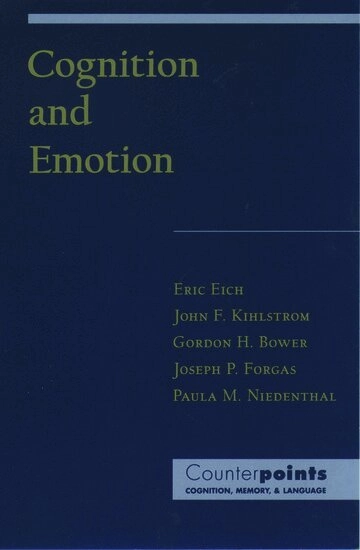
Cognition and emotion
- Utgiven: 2000
- ISBN: 9780195113341
- Sidor: 272 st
- Förlag: Oxford University Press
- Format: Häftad
- Språk: Engelska
Om boken
Recent years have witnessed a revival of research in the interplay between cognition and emotion. The reasons for this renaissance are many and varied. In the first place, emotion theorists have come to recognise the pivotal role of cognitive factors in virtually all aspects of the emotion process, and to rely on basic cognitive factors insight in creating new models of affective space. Also, the successful application of cognitive therapies to affective disorders has promoted clinical psychologists to work towards a clearer understanding of the connections between cognitive processes and emotional problems. And whereas the cognitive revolutionaries of the 1960s regarded emotions with suspicion, viewing them as nagging sources of 'hot' noise in an otherwise cool, rational, and computer-like system of information processing, cognitive researchers of the 1990s regard emotions with respect, owing to their potent and predictable effects on tasks as diverse as object perception, episodic recall, and risk assessment. These intersecting lines of interest have made cognition and emotion one of the most active and rapidly developing areas within psychological science.
Åtkomstkoder och digitalt tilläggsmaterial garanteras inte med begagnade böcker
Mer om Cognition and emotion (2000)
2000 släpptes boken Cognition and emotion skriven av Eric Eich. Den är skriven på engelska och består av 272 sidor. Förlaget bakom boken är Oxford University Press.
Köp boken Cognition and emotion på Studentapan och spara pengar.
Referera till Cognition and emotion
Harvard
Eich, E. (2000). Cognition and emotion. Oxford University Press.
Oxford
Eich, Eric, Cognition and emotion (Oxford University Press, 2000).
APA
Eich, E. (2000). Cognition and emotion. Oxford University Press.
Vancouver
Eich E. Cognition and emotion. Oxford University Press; 2000.
citeproc-js implements the Citation Style Language. (c) Frank Bennett. Licenser och källkod.