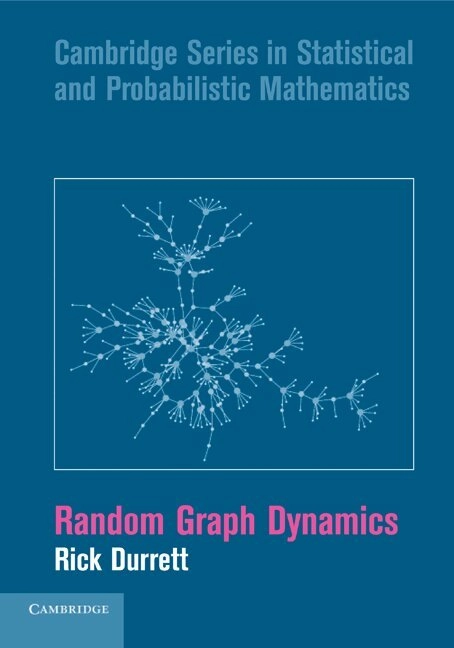
Random graph dynamics
- Utgiven: 2007
- ISBN: 9780521150163
- Sidor: 220 st
- Förlag: Cambridge University Press
- Format: Häftad
- Språk: Engelska
Om boken
The theory of random graphs began in the late 1950s in several papers by Erdos and Renyi. In the late twentieth century, the notion of six degrees of separation, meaning that any two people on the planet can be connected by a short chain of people who know each other, inspired Strogatz and Watts to define the small world random graph in which each site is connected to k close neighbors, but also has long-range connections. At about the same time, it was observed in human social and sexual networks and on the Internet that the number of neighbors of an individual or computer has a power law distribution. This inspired Barabasi and Albert to define the preferential attachment model, which has these properties. These two papers have led to an explosion of research. While this literature is extensive, many of the papers are based on simulations and nonrigorous arguments. The purpose of this book is to use a wide variety of mathematical argument to obtain insights into the properties of these graphs. A unique feature of this book is the interest in the dynamics of process taking place on the graph in addition to their geometric properties, such as connectedness and diameter.
Åtkomstkoder och digitalt tilläggsmaterial garanteras inte med begagnade böcker
Mer om Random graph dynamics (2007)
2007 släpptes boken Random graph dynamics skriven av Richard Durrett. Den är skriven på engelska och består av 220 sidor. Förlaget bakom boken är Cambridge University Press.
Köp boken Random graph dynamics på Studentapan och spara pengar.
Referera till Random graph dynamics
Harvard
Durrett, R. (2007). Random graph dynamics. Cambridge University Press.
Oxford
Durrett, Richard, Random graph dynamics (Cambridge University Press, 2007).
APA
Durrett, R. (2007). Random graph dynamics. Cambridge University Press.
Vancouver
Durrett R. Random graph dynamics. Cambridge University Press; 2007.
citeproc-js implements the Citation Style Language. (c) Frank Bennett. Licenser och källkod.