Begagnad
Begagnad
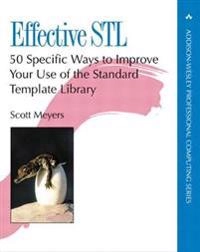
Effective STL : 50 specific ways to improve your use of the standard template libraryUpplaga 1
- Upplaga: 1a upplagan
- Utgiven: 2001
- ISBN: 9780201749625
- Sidor: 288 st
- Förlag: Boston, Mass. Addison-Wesley
- Format: Häftad
- Språk: Engelska
Om boken
Preface xiAcknowledgments xvIntroduction 1Chapter 1: Containers 11 Item 1: Choose your containers with care. 11
Item 2: Beware the illusion of container-independent code. 15
Item 3: Make copying cheap and correct for objects in containers. 20
Item 4: Call empty instead of checking size() against zero. 23
Item 5: Prefer range member functions to their single-element counterparts. 24
Item 6: Be alert for C++’s most vexing parse. 33
Item 7: When using containers of newed pointers, remember to delete the pointers before the container is destroyed. 36
Item 8: Never create containers of auto_ptrs. 40
Item 9: Choose carefully among erasing options. 43
Item 10: Be aware of allocator conventions and restrictions. 48
Item 11: Understand the legitimate uses of custom allocators. 54
Item 12: Have realistic expectations about the thread safety of STL containers. 58
Chapter 2: vector and string 63 Item 13: Prefer vector and string to dynamically allocated arrays. 63
Item 14: Use reserve to avoid unnecessary reallocations. 66
Item 15: Be aware of variations in string implementations. 68
Item 16: Know how to pass vector and string data to legacy APIs. 74
Item 17: Use “the swap trick” to trim excess capacity. 77
Item 18: Avoid using vector. 79
Chapter 3: Associative Containers 83 Item 19: Understand the difference between equality and equivalence. 83
Item 20: Specify comparison types for associative containers of pointers. 88
Item 21: Always have comparison functions return false for equal values. 92
Item 22: Avoid in-place key modification in set and multiset. 95
Item 23: Consider replacing associative containers with sorted vectors. 100
Item 24: Choose carefully between map::operator[] and map::insert when efficiency is important. 106
Item 25: Familiarize yourself with the nonstandard hashed containers. 111
Chapter 4: Iterators 116 Item 26: Prefer iterator to const_iterator, reverse_iterator, and const_reverse_iterator. 116
Item 27: Use distance and advance to convert const_iterators to iterators. 120
Item 28: Understand how to use a reverse_iterator’s base iterator. 123
Item 29: Consider istreambuf_iterators for character by character input. 126
Chapter 5: Algorithms 128 Item 30: Make sure destination ranges are big enough. 129
Item 31: Know your sorting options. 133
Item 32: Follow remove-like algorithms by erase if you really want to remove something. 139
Item 33: Be wary of remove-like algorithms on containers of pointers. 143
Item 34: Note which algorithms expect sorted ranges. 146
Item 35: Implement simple case-insensitive string comparisons via mismatch or lexicographical_compare. 150
Item 36: Understand the proper implementation of copy_if. 154
Item 37: Use accumulate or for_each to summarize ranges. 156
Chapter 6: Functors, Functor Classes, Functions, etc. 162 Item 38: Design functor classes for pass-by-value. 162
Item 39: Make predicates pure functions. 166
Item 40: Make functor classes adaptable. 169
Item 41: Understand the reasons for ptr_fun, mem_fun, and mem_fun_ref. 173
Item 42: Make sure less means operator
Chapter 7: Programming with the STL 181 Item 43: Prefer algorithm calls to hand-written loops. 181
Item 44: Prefer member functions to algorithms with the same names. 190
Item 45: Distinguish among count, find, binary_search, lower_bound, upper_bound, and equal_range. 192
Item 46: Consider function objects instead of functions as algorithm parameters. 201
Item 47: Avoid producing write-only code. 206
Item 48: Always #include the proper headers. 209
Item 49: Learn to decipher STL-related compiler diagnostics. 210
Item 50: Familiarize yourself with STL-related web sites. 217
Bibliography 225Appendix A: Locales and Case-Insensitive String Comparisons 229Appendix B: Remarks on Microsoft’s STL Platforms 239Index 245
Åtkomstkoder och digitalt tilläggsmaterial garanteras inte med begagnade böcker
Mer om Effective STL : 50 specific ways to improve your use of the standard template library (2001)
2001 släpptes boken Effective STL : 50 specific ways to improve your use of the standard template library skriven av Scott Meyers. Det är den 1a upplagan av kursboken. Den är skriven på engelska och består av 288 sidor. Förlaget bakom boken är Boston, Mass. Addison-Wesley.
Köp boken Effective STL : 50 specific ways to improve your use of the standard template library på Studentapan och spara pengar.
Referera till Effective STL : 50 specific ways to improve your use of the standard template library (Upplaga 1)
Harvard
Meyers, S. (2001). Effective STL : 50 specific ways to improve your use of the standard template library. 1:a uppl. Boston, Mass. Addison-Wesley.
Oxford
Meyers, Scott, Effective STL : 50 specific ways to improve your use of the standard template library, 1 uppl. (Boston, Mass. Addison-Wesley, 2001).
APA
Meyers, S. (2001). Effective STL : 50 specific ways to improve your use of the standard template library (1:a uppl.). Boston, Mass. Addison-Wesley.
Vancouver
Meyers S. Effective STL : 50 specific ways to improve your use of the standard template library. 1:a uppl. Boston, Mass. Addison-Wesley; 2001.