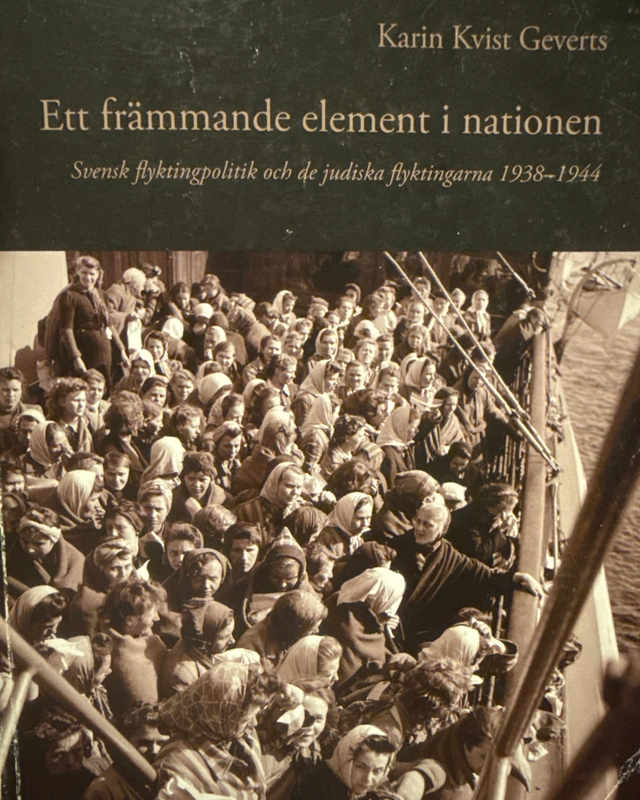
Ett främmande element i nationen : svensk flyktingpolitik och de judiska flyktingarna 1938-1944 = A foreign element within the nation : Swedish refugee policy and the jewish refugees 1938-1944
- Utgiven: 2008
- ISBN: 9789197743419
- Sidor: 324 st
- Förlag: Acta Universitatis Upsaliensis (AUU
- Språk: Svenska
Om boken
Discusses social categorization and discrimination in light of Swedish refugee policy vis-à-vis Jews during World War II. The Swedish policy was shaped by decisions on an administrative rather than a political level, leaving immigration authorities freedom of action. A quantitative study of minutes and dossiers of both the Foreigners Bureau of the National Board of Health and the Ministry of Foreign Affairs shows that there is a statistically significant connection between refugees categorized as Jews and a much lower probability of admission (52%) compared to non-Jews (82%). Swedish authorities also preferred that Jewish refugees apply for visas before arriving in Sweden, so that they could perform a pre-selection. Rejects the view that the refugee policy was alleviated after the "Kristallnacht" pogrom. Although a larger number of Jews were allowed to enter Sweden in November 1938 compared to October, the number of applications had also grown, as had the percentage of rejections. The authorities developed a practice of postponing decisions, and as of fall 1941, also began to motivate rejection. A shift in Swedish refugee policy from bystander to rescuer did take place in 1942, but it was gradual. Concludes that Swedish refugee policy constituted a mix of sincere humanitarianism, expressed in Sweden's participation in international large-scale rescue operations, and calculations based on antisemitic prejudice and pragmatic considerations.
Åtkomstkoder och digitalt tilläggsmaterial garanteras inte med begagnade böcker
Mer om Ett främmande element i nationen : svensk flyktingpolitik och de judiska flyktingarna 1938-1944 = A foreign element within the nation : Swedish refugee policy and the jewish refugees 1938-1944 (2008)
2008 släpptes boken Ett främmande element i nationen : svensk flyktingpolitik och de judiska flyktingarna 1938-1944 = A foreign element within the nation : Swedish refugee policy and the jewish refugees 1938-1944 skriven av Karin Kvist Geverts. Den är skriven på svenska och består av 324 sidor. Förlaget bakom boken är Acta Universitatis Upsaliensis (AUU.
Köp boken Ett främmande element i nationen : svensk flyktingpolitik och de judiska flyktingarna 1938-1944 = A foreign element within the nation : Swedish refugee policy and the jewish refugees 1938-1944 på Studentapan och spara pengar.
Referera till Ett främmande element i nationen : svensk flyktingpolitik och de judiska flyktingarna 1938-1944 = A foreign element within the nation : Swedish refugee policy and the jewish refugees 1938-1944
Harvard
Geverts, K. K. (2008). Ett främmande element i nationen : svensk flyktingpolitik och de judiska flyktingarna 1938-1944 = A foreign element within the nation : Swedish refugee policy and the jewish refugees 1938-1944. Acta Universitatis Upsaliensis (AUU.
Oxford
Geverts, Karin Kvist, Ett främmande element i nationen : svensk flyktingpolitik och de judiska flyktingarna 1938-1944 = A foreign element within the nation : Swedish refugee policy and the jewish refugees 1938-1944 (Acta Universitatis Upsaliensis (AUU, 2008).
APA
Geverts, K. K. (2008). Ett främmande element i nationen : svensk flyktingpolitik och de judiska flyktingarna 1938-1944 = A foreign element within the nation : Swedish refugee policy and the jewish refugees 1938-1944. Acta Universitatis Upsaliensis (AUU.
Vancouver
Geverts KK. Ett främmande element i nationen : svensk flyktingpolitik och de judiska flyktingarna 1938-1944 = A foreign element within the nation : Swedish refugee policy and the jewish refugees 1938-1944. Acta Universitatis Upsaliensis (AUU; 2008.