Begagnad
Begagnad
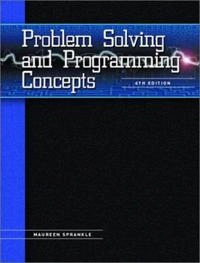
Problem Solving and Program ConceptsUpplaga 6
- Upplaga: 6e upplagan
- Utgiven: 2003
- ISBN: 9780131228078
- Sidor: 536 st
- Förlag: Pearson
- Format: Häftad
- Språk: Engelska
Om boken
This text covers the basic problem-solving concepts that readers need to know and understand when working in any computer language or application. With detailed explanations and numerous illustrations, it encompasses all fundamental areas of problem solving from the basics of mathematical functions and operators to the design and use of codes, indicators, control breaks, arrays, pointers, file updates, and report handling. Problem-solving tools, including problem analysis charts, interactive charts, IPO charts, algorithms, and flowcharts are used to design a solution to a problem.
This edition is divided into six parts, organized as follows: Unit 1, Introduction to Problem Solving and ProgrammingProblem solving, an introduction to how problems are solved on computers, mathematical concepts, and steps for analyzing a problem and designing an appropriate solution
Unit 2, Programming Logic StructureProgramming that includes local and global variables, parameters, and sequential, decision, loop, and case logic structures
Unit 3, Data StructuresArrays, sorting techniques, search methods, stacks, linked lists, binary trees, and databases
Unit 4, Object-Oriented ProgrammingDesign of a solution using object-oriented languages
Unit 5, File ProcessingFile concepts, sequential file processing, and random access file processing
Unit 6, Problem Solving for Application SoftwareWord processing, design, spreadsheets, and information processing
Åtkomstkoder och digitalt tilläggsmaterial garanteras inte med begagnade böcker
Mer om Problem Solving and Program Concepts (2003)
I maj 2003 släpptes boken Problem Solving and Program Concepts skriven av Harry Finestone, Michael F. Shugrue. Det är den 6e upplagan av kursboken. Den är skriven på engelska och består av 536 sidor. Förlaget bakom boken är Pearson som har sitt säte i London.
Köp boken Problem Solving and Program Concepts på Studentapan och spara pengar.
Referera till Problem Solving and Program Concepts (Upplaga 6)
Harvard
Finestone, H. & Shugrue, M. F. (2003). Problem Solving and Program Concepts. 6:e uppl. Pearson.
Oxford
Finestone, Harry & Shugrue, Michael F., Problem Solving and Program Concepts, 6 uppl. (Pearson, 2003).
APA
Finestone, H., & Shugrue, M. F. (2003). Problem Solving and Program Concepts (6:e uppl.). Pearson.
Vancouver
Finestone H, Shugrue MF. Problem Solving and Program Concepts. 6:e uppl. Pearson; 2003.